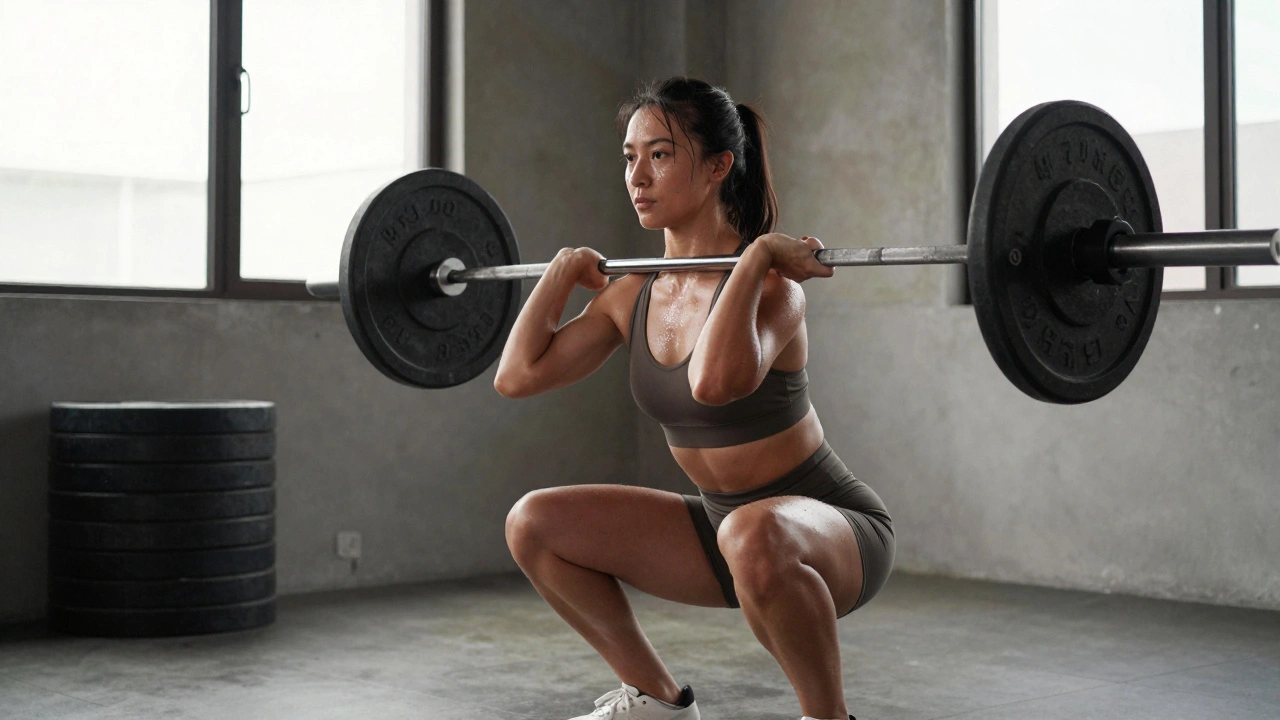
When you see a fitness model with defined abs, bulging biceps, and lean legs, it’s easy to think their physique came from magic. But the truth? It’s built one rep, one meal, one recovery day at a time. And the people who’ve done it-fitness models-know exactly what works. They don’t follow trends. They stick to what moves the needle. Here’s what they actually do to build serious muscle mass.
Train Heavy, Not Just Long
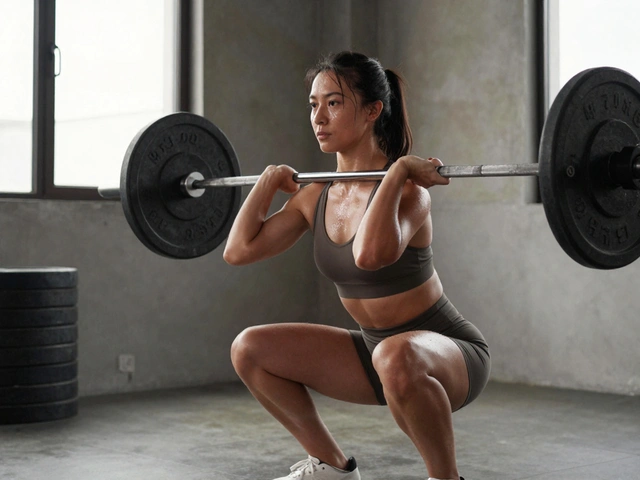
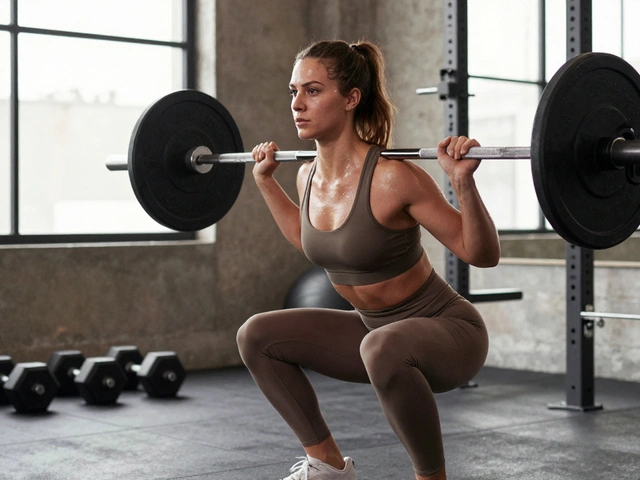
Fitness models don’t spend hours on treadmills or do 20 sets of bicep curls with light weights. They lift heavy. Not because it’s trendy, but because science and experience prove it works. Most top fitness models stick to compound lifts: squats, deadlifts, bench presses, overhead presses, and pull-ups. These movements engage multiple muscle groups at once, triggering the most muscle growth.
One model, who’s been featured in five fitness magazines over the last three years, shared that she only trains each muscle group once a week-but with enough volume to exhaust it. That means 3-5 sets of 6-8 reps per exercise, with weights that make the last rep nearly impossible. She doesn’t chase pump. She chases strength. And that’s the key.
Progressive overload isn’t a buzzword-it’s the rule. If you’re lifting the same weight week after week, you’re not growing. You’re maintaining. Fitness models increase weight, reps, or sets every two to three weeks. No exceptions.
Protein Isn’t Optional-It’s Your Foundation
"I eat protein like it’s oxygen," says a male fitness model who’s been on the cover of Men’s Health UK twice. He eats 2.2 grams of protein per kilogram of body weight every single day. That’s not a suggestion. That’s his baseline.
For someone weighing 80 kg (176 lbs), that’s 176 grams of protein daily. Where does it come from? Chicken, eggs, lean beef, cottage cheese, Greek yogurt, and whey protein. No fancy supplements. Just real food, timed right.
They spread it out. Four meals a day, each with at least 40 grams of protein. Why? Because your body can only use so much protein at once. Studies show the max muscle-building response per meal tops out around 40 grams. Eating it all in one shake? Wasted. Spreading it out? Consistent growth.
And no, you don’t need to eat protein every two hours. Just hit your daily target and space it evenly. Most fitness models don’t even track calories. They track protein. And they’re consistent.
Rest Is Part of the Workout
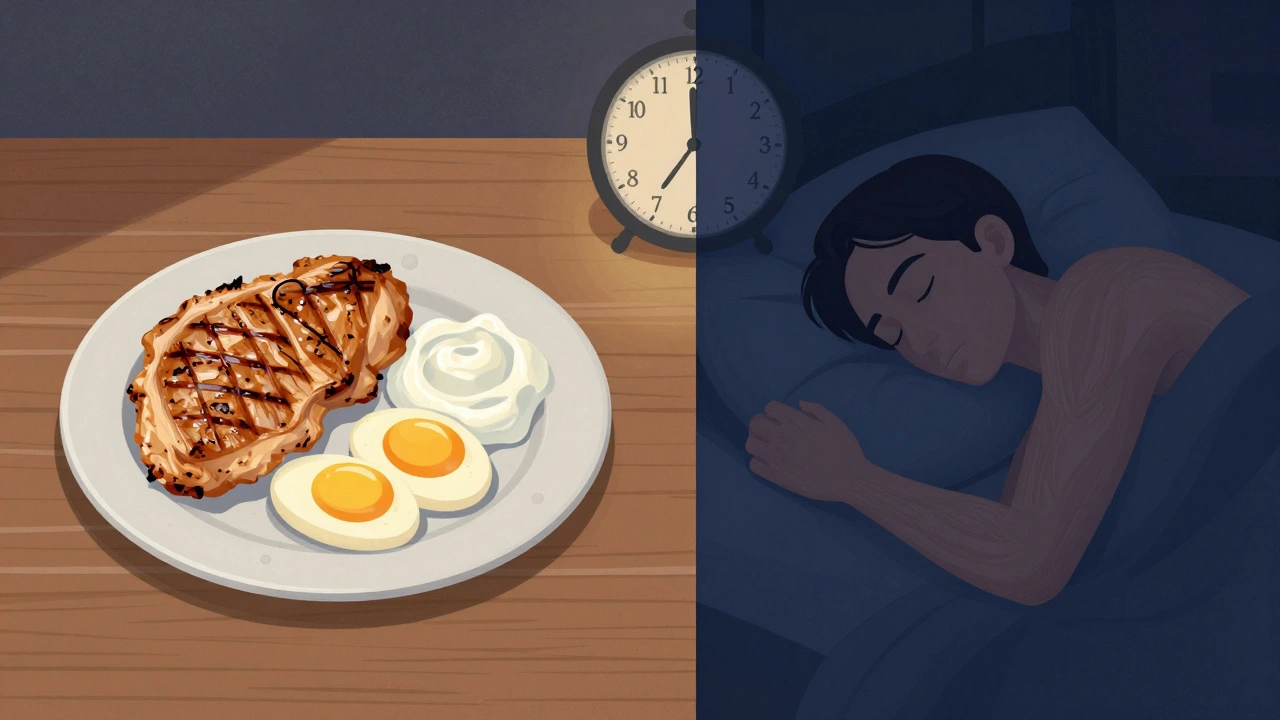
Here’s what no one tells you: muscle doesn’t grow when you lift. It grows when you sleep. Fitness models treat sleep like a non-negotiable appointment. Seven to eight hours. Every night. No exceptions.
One female model, who trains six days a week, says she cancels social plans if she knows she won’t get enough rest. She’s seen what happens when she skimps: stalled progress, soreness that never fades, and a drop in performance. Recovery isn’t passive. It’s active muscle repair.
They also take at least one full rest day per week. No cardio. No stretching. Just lying on the couch, hydrating, and letting their body heal. Some even use infrared saunas or foam roll for 15 minutes after training. Not to burn calories. To reduce inflammation.
And yes-they nap. A 20-minute power nap after a heavy leg day? Common. It’s not laziness. It’s strategy.
Stop Doing the Same Routine
Fitness models rarely do the same workout for more than six weeks. Why? Because your body adapts. Fast.
They rotate their training styles every 4-6 weeks:
- Weeks 1-6: Heavy strength focus (5-8 reps)
- Weeks 7-12: Moderate volume (8-12 reps) with supersets
- Weeks 13-16: Density training (short rest, high reps, compound lifts)
- Weeks 17-20: Deload week-50% weight, 50% volume
This isn’t about variety for fun. It’s about forcing new adaptations. When you hit a plateau, they don’t add more sets. They change the stimulus. Switch from barbell squats to Bulgarian split squats. Swap bench press for dumbbell floor press. Change the tempo. Slow the eccentric. Add pauses.
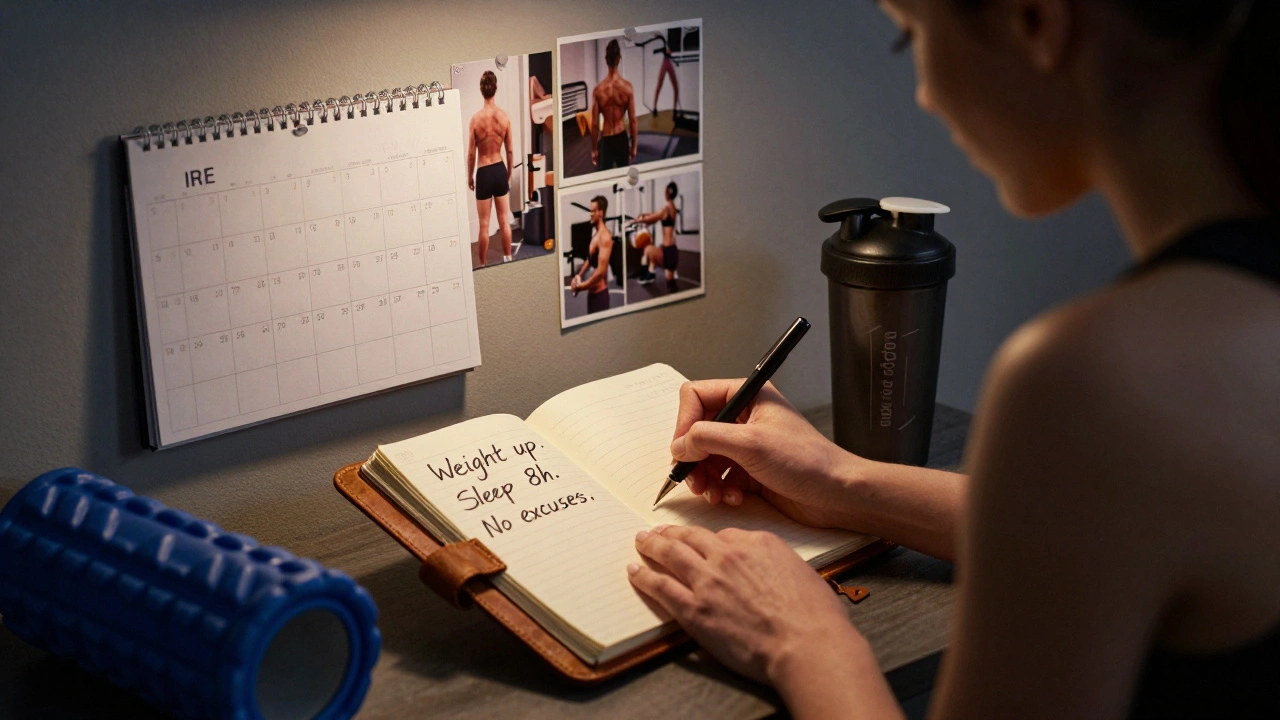
One model told me he keeps a notebook. Every workout, he writes down: weight, reps, how it felt, and whether he’ll repeat it. If a movement doesn’t challenge him after three sessions, he replaces it. No sentimentality. Just results.
Track Progress-But Not Just the Scale
Fitness models don’t weigh themselves daily. They take measurements every two weeks: arms, chest, thighs, waist. They also take progress photos under the same lighting, same time of day, same outfit. No filters. Just raw, honest visuals.
They know the scale lies. Muscle weighs more than fat. You can gain 3 pounds of muscle and lose 5 pounds of fat-and the scale says you lost 2. That’s a win. But if you only look at the number, you’ll quit.
They also track strength. If your bench press went from 100 kg to 110 kg in eight weeks, you’re building muscle-even if your waist hasn’t shrunk yet. Strength gains = muscle gains. Period.
Some use apps like Strong or JEFIT. Others just write it in a notebook. It doesn’t matter how you track. What matters is that you do.
Consistency Beats Intensity
The biggest mistake people make? They go all-in for two weeks, then quit. Fitness models don’t do that. They show up. Even when they’re tired. Even when they’re busy. Even when they don’t feel like it.
One model, who trains in Oxford, says he’s missed only two workouts in the last 18 months. One was because he had the flu. The other? He was traveling and didn’t have access to a gym. He did bodyweight exercises in his hotel room instead.
They don’t wait for motivation. They build systems. A fixed workout time. A grocery list that’s always stocked with protein. A pre-workout ritual. A post-workout recovery routine. These habits stack up. Over months. Over years.
You don’t need to be perfect. You need to be consistent. Miss a workout? No problem. Just get back on track the next day. One missed day doesn’t ruin progress. Three weeks off? That does.
What They Don’t Do
Fitness models avoid these traps:
- Overdoing cardio-unless they’re prepping for a competition. Too much burns muscle.
- Chasing lean cuts too early. If you’re under 10% body fat and still trying to build muscle, you’re fighting your body.
- Using gimmicks-fat burners, detox teas, unproven supplements. Real muscle doesn’t come in a pill.
- Comparing themselves to edited photos. Social media is a highlight reel. Real progress takes time.
They also don’t follow every influencer. They pick one or two coaches they trust, stick with their plan for six months, and adjust only when needed.
Start Now-Not Tomorrow
You don’t need a personal trainer. You don’t need a $200 supplement stack. You don’t need to train for six hours a week. You need three things:
- Heavy compound lifts, three to four times a week
- At least 2.2g of protein per kg of body weight, spread across meals
- Sleep. Seven hours. Every night.
That’s it. No magic. No secrets. Just science, discipline, and time.
Start with your next workout. Lift heavier than last time. Eat one extra egg at breakfast. Go to bed 30 minutes earlier. Do that for 30 days. Then check your progress. You’ll be surprised.
How much protein do fitness models really eat to build muscle?
Most fitness models consume between 2.0 and 2.5 grams of protein per kilogram of body weight daily. For example, a 75 kg person would eat 150-187 grams of protein per day. They spread this across 4-5 meals to maximize muscle protein synthesis. This isn’t about excess-it’s about consistent supply.
Do fitness models do cardio while building muscle?
They do light cardio, but only for health, not fat loss. One or two 20-minute sessions of walking, cycling, or rowing per week. They avoid long, intense cardio because it interferes with muscle recovery and can break down lean tissue. Cardio is maintenance, not muscle-building.
How long does it take to see noticeable muscle gains like fitness models?
Beginners can see visible changes in 8-12 weeks with consistent training and proper nutrition. Real, dramatic transformation-like that of a fitness model-takes 12-24 months. It’s not about quick fixes. It’s about years of disciplined habits. The models you see on social media didn’t get there in six weeks.
Should I follow a fitness model’s exact workout routine?
No. Their routines are tailored to their genetics, experience, and goals. What you should copy is the structure: heavy compounds, progressive overload, protein timing, and recovery. Adapt the exercises to your equipment and ability. A beginner doesn’t need to squat 150 kg. They need to learn the movement and get stronger over time.
Can I build muscle without supplements?
Absolutely. Every fitness model who’s built their physique naturally does it with whole foods. Whey protein is convenient, but not essential. You can get all the protein you need from chicken, eggs, fish, dairy, and legumes. Supplements help fill gaps-they don’t create muscle. Food does.
Why do fitness models look leaner than bodybuilders?
Fitness models prioritize aesthetics over sheer size. They train for symmetry, definition, and proportion-not maximum mass. They keep body fat lower (10-14% for men, 16-20% for women) while maintaining muscle. Bodybuilders often carry more fat to support massive muscle growth, then cut down for shows. Fitness models stay lean year-round.




February 4, 2026 AT 21:47
Bethany Wappler
Let me just say this: muscle isn't built in the gym. It's built in the kitchen, in the quiet hours before dawn, and in the stillness of a sleep-deprived night when you choose rest over scrolling.
People think fitness models have some secret algorithm, but no-it's just consistency wrapped in discipline. They don't 'motivate' themselves. They show up because their identity is built on it.
I used to think I needed a 2-hour routine, fancy supplements, and a personal trainer. Then I started doing three compound lifts, three times a week, with just eggs, chicken, and sleep. Six months later? I looked in the mirror and didn't recognize myself.
Progress isn't loud. It doesn't post selfies. It doesn't need hashtags. It just shows up, day after day, even when you're tired, even when you're doubting.
The real magic? It's not in the weight you lift. It's in the choice to lift it again tomorrow.
Start small. Stay steady. Let time do the rest. You don't need to be perfect. You just need to be present.
And if you miss a day? Don't punish yourself. Just show up the next one. That's the whole game.
-Bethany
February 5, 2026 AT 05:14
Jenn Davenport
OMG YES THIS. 😭 I’ve been trying to build muscle for 2 years and I was doing ALL the wrong things-too much cardio, not enough protein, skipping sleep because ‘I’ll rest when I’m done’ 🙃
Then I started eating 4 eggs at breakfast (yes, FOUR) and going to bed at 10:30 pm like my life depended on it… and guess what? My arms finally started looking like arms. Not ‘maybe I’m getting stronger’ arms. ACTUAL arms.
Also-nap after leg day? YES. I nap. I don’t care who sees me. My body says THANK YOU.
Thank you for saying it like it is. No fluff. Just truth. 💪❤️
February 5, 2026 AT 21:32
Dan Mihai
Let’s be real-the majority of these so-called ‘fitness models’ are just genetically gifted outliers with access to personal chefs, physiotherapists, and photobooths. The 2.2g/kg protein recommendation? That’s for elite athletes, not your average Joe trying to get abs while working 9-5.
Most people don’t need that much. In fact, excessive protein intake can strain renal function over time. And let’s not even get into the anabolic window fallacy-it’s been debunked since 2017.
You don’t need to ‘chase strength.’ You need to optimize hypertrophy via time-under-tension and metabolic stress. Compound lifts? Fine. But don’t ignore isolation work. Symmetry > brute force.
And please. ‘No supplements’? That’s naive. Creatine monohydrate has 200+ peer-reviewed studies backing it. You’re not ‘natural’ if you’re ignoring the science.
-Dan
February 6, 2026 AT 02:51
gangadhar balina
India has been producing world-class athletes for decades without any of this Western nonsense.
You think protein is magic? We’ve been eating dal, paneer, and eggs since before your great-grandparents were born.
And sleep? We sleep on the floor. We wake at 4 AM. We train barefoot in the park. No infrared saunas. No JEFIT apps. Just discipline.
These fitness models? They’re just glorified gym bros with Instagram filters.
Real strength? It’s in the village. It’s in the sweat. It’s in the silence of a man who lifts 100kg with his bare hands while his children eat.
Stop copying Western trends. Build your own path.
-Gangadhar
February 6, 2026 AT 20:22
Michelle Yu
Okay but can we talk about how everyone ignores the fact that fitness models don’t even train like this year-round? They cycle. They’re in ‘off-season’ mode for 8 months where they eat like normal humans and lift 60% of their max.
The ‘2.2g/kg’ thing? That’s competition prep. Not maintenance.
Most of them look like that because they’re in a 3-month calorie deficit and doing 2 hours of cardio daily. Then they get photographed, and suddenly it’s ‘this is how you build muscle.’
It’s a trap. Don’t fall for it.
Also-napping? Cute. I work two jobs. I don’t have time for power naps. I have time for one decent meal and a 6-hour sleep. That’s reality.
-Michelle
February 7, 2026 AT 11:04
Dustin Lauck
Wow. Someone finally said it: muscle doesn’t grow from Instagram posts.
It grows from showing up when you’re bored. When you’re tired. When you’ve had the same protein shake for 17 days straight and you’re sick of it.
And yes, the 2.2g/kg is real. But here’s the thing-most people don’t need to track it. They need to eat enough protein to stop feeling weak. If you’re not hungry after a workout, you’re not eating enough.
And sleep? It’s not a luxury. It’s your body’s only recovery tool. If you’re sleeping 5 hours, you’re not building muscle-you’re just burning calories while pretending to be a gym bro.
Also-no, you don’t need to rotate workouts every 6 weeks. That’s just a marketing tactic from app developers. Do what works. Stick with it. Get stronger. Repeat.
And for god’s sake, stop comparing yourself to someone who got their photo taken in 20 minutes with 12 filters.
Real progress? It’s invisible. Until one day, you look in the mirror and realize… you’ve been building this whole time.
-Dustin