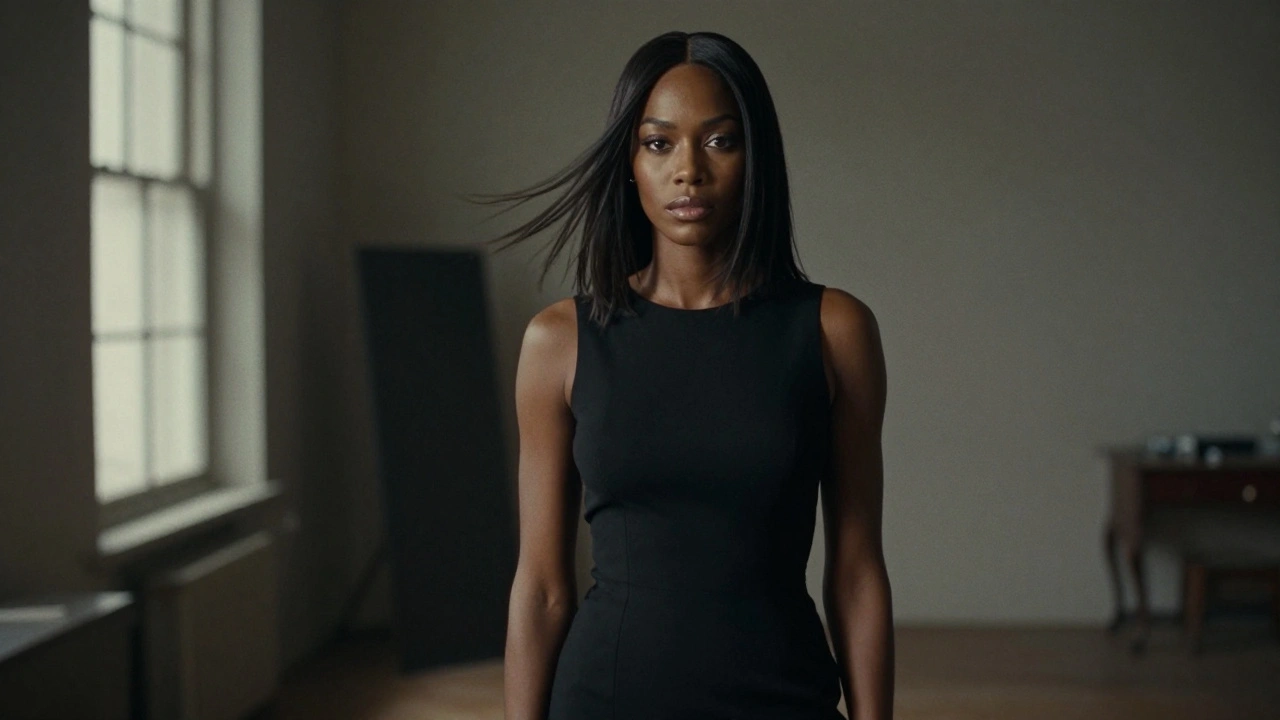
Some magazine covers don’t just sell issues-they stop people in their tracks. They become part of culture, stuck on bedroom walls, shared on social media, and talked about for decades. When a hot model appears on the front of a major fashion magazine, it’s rarely just about looks. It’s about attitude, timing, and the perfect storm of style, lighting, and personality.
1991: Naomi Campbell on Vogue
Naomi Campbell’s March 1991 cover for Vogue didn’t just break barriers-it rewrote the rules. Shot by Peter Lindbergh, the cover showed her in a simple black dress, no makeup, no flash, just raw power. She wasn’t posing. She was commanding. At 21, she became the first Black woman to grace the cover of American Vogue solo in over 30 years. The image wasn’t about being "hot" in the way we think of it today-it was about presence. And that presence made her unforgettable. This cover didn’t just launch a career; it changed who got to be on the cover at all.
1996: Kate Moss on The Face
Kate Moss didn’t need high heels or diamonds to dominate a cover. In 1996, she appeared on the cover of The Face in a cropped white T-shirt, messy hair, and a half-smile that said more than words ever could. The photo, taken by Corinne Day, captured the grunge era’s raw honesty. Moss looked like she’d just rolled out of bed-but everyone wanted to be her. She wasn’t the tallest, the curviest, or the most polished. But she was real. And that realness made her the most desirable model of the decade. This cover didn’t sell clothes. It sold a feeling: effortless, cool, unapologetic.
2002: Gisele Bündchen on Sports Illustrated Swimsuit Issue
When Gisele Bündchen stepped onto the beach in her bikini for the 2002 Sports Illustrated Swimsuit Issue, she didn’t just appear on a cover-she became a phenomenon. Shot on a remote beach in the Bahamas, the image showed her walking away from the camera, sun glinting off her skin, hair blowing in the wind. It wasn’t overtly sexual. It was elemental. She looked like a goddess carved from sunlight and saltwater. The issue sold over 1.5 million copies-the highest in the magazine’s history at the time. Gisele wasn’t just a model; she became the face of a new kind of beauty: athletic, confident, and naturally radiant.
2010: Beyoncé on Elle
Beyoncé’s July 2010 cover for Elle was a cultural reset. Dressed in a barely-there lace bodysuit, her body lit like a Renaissance painting, she looked both divine and dangerously human. The shoot, by fashion photographer David LaChapelle, blurred the line between pop star and supermodel. She wasn’t posing as a model-she was owning the role. The cover sparked debates about race, body image, and femininity. It wasn’t just a pretty picture. It was a statement. And it made her the first Black woman to grace the cover of Elle in a solo feature in over a decade. That cover didn’t just sell magazines-it made headlines for weeks.

2015: Gigi Hadid on Harper’s Bazaar
Gigi Hadid’s April 2015 cover for Harper’s Bazaar arrived at the peak of the Instagram model era. But unlike most digital-era covers, this one felt timeless. Shot in black and white by Steven Meisel, Gigi stared straight into the lens with a quiet intensity. Her hair was slicked back, her expression unreadable. No smile. No fluff. Just steel and skin. She looked like a future icon before anyone had fully recognized it. The cover went viral-not because of her outfit, but because of her gaze. It wasn’t about being hot. It was about being unforgettable. That single image defined the shift from "pretty model" to "powerful figure."
2020: Adut Akech on Vogue Australia
In January 2020, Adut Akech, a former refugee from South Sudan, appeared on the cover of Vogue Australia in a bold red gown, her hair shaved on one side, the other flowing like silk. Shot by Tim Walker, the image was both regal and revolutionary. She didn’t wear jewelry. She didn’t need it. Her presence alone was the statement. This cover mattered because it showed that "hot" isn’t tied to a single body type, skin tone, or background. Adut wasn’t just beautiful-she was a symbol of resilience, diversity, and the future of fashion. The cover became a rallying point for change in an industry still struggling with inclusion.
Why These Covers Last
What separates these covers from the thousands of other model shots taken every year? It’s not just the model’s looks. It’s the story behind the image. Each of these covers captured a moment-social, cultural, or emotional-that resonated far beyond fashion pages. They didn’t follow trends. They set them.
Many magazine covers today rely on filters, lighting tricks, and airbrushing. But the most memorable ones? They were shot with truth. The models looked like they meant something. Like they weren’t just there to look good, but to say something.
And that’s why people still talk about them. Not because they were the most naked, the most posed, or the most glamorous. But because they felt real.

What Makes a Cover "Hot"?
"Hot" isn’t just about curves or skin. It’s about energy. It’s about how a model holds the camera’s attention-not by staring, but by making you feel like you’re witnessing something private. A half-smile. A turned shoulder. A glance that says, "I know you’re looking, but I don’t care."
Look at the covers that stuck. The models had control. They weren’t passive objects. They were collaborators. They chose their expressions. They moved their bodies. They brought their own history into the frame.
Today, many "hot" covers are made for clicks. But the classics? They were made to last.
How the Industry Changed
Twenty years ago, a model had to be signed to a top agency, walk in Paris, and be photographed by a legendary name to land a major cover. Now, someone can go from Instagram to Vogue in six months. But the standards haven’t lowered-they’ve just shifted.
The new generation of models-like Kaia Gerber, Irina Shayk, and Bella Hadid-don’t just rely on beauty. They bring personality, activism, and authenticity. They speak. They post. They own their image. And that’s what makes their covers stick.
The old rule was: "Be perfect." The new rule? "Be real." And that’s why today’s covers feel more powerful than ever.
What’s Missing Today?
There are more models than ever. More covers. More photos. But fewer moments that stop you.
Why? Because too many are made for algorithms, not emotion. Too many are edited until the soul is gone. Too many feel like they were designed to be shared, not remembered.
The covers that truly last? They’re the ones that feel like they were made by someone who knew they were making history-not just content.
Final Thought
Some covers are forgotten by the next month. Others become part of your life. You see them in documentaries. You print them out. You show them to your friends. You say, "This is the one."
Those are the covers that matter. Not because the model was the hottest. But because she was unforgettable.
What makes a magazine cover with a model memorable?
A memorable cover isn’t just about how a model looks-it’s about emotion, timing, and authenticity. The best ones capture a cultural moment, show personality, and feel real. Think of Naomi Campbell’s 1991 Vogue cover: it wasn’t flashy, but it changed fashion forever because it carried weight. Memorable covers make you feel something, not just look.
Are today’s magazine covers as impactful as those from the 90s?
They’re different, not weaker. The 90s had fewer covers, so each one had more weight. Today, there are hundreds of covers every month, so individual impact is harder to achieve. But when a modern cover like Adut Akech’s 2020 Vogue Australia lands, it hits just as hard. The difference is context: today’s covers often carry social messages about diversity, identity, and power, making them just as powerful-if not more-than the past.
Do models still get famous from magazine covers today?
Yes, but it’s not the only path anymore. In the 90s, a Vogue cover could launch a career overnight. Today, models often build fame through Instagram first. But landing a major cover like Elle or Harper’s Bazaar still signals elite status. It’s the final stamp of credibility. Models like Gigi Hadid and Kaia Gerber used covers to cement their status after already going viral online.
Why do some models look "hotter" on covers than others?
It’s not about their body-it’s about how the photo is made. Lighting, angle, expression, and even the model’s confidence in the moment make the difference. A model who feels powerful on set will project that in the image. That’s why some covers feel electric, even if the model isn’t conventionally "hot." It’s about energy, not measurements.
Can a cover make a model a legend?
Absolutely. Naomi Campbell, Kate Moss, and Cindy Crawford became legends not just because they were beautiful, but because of the covers that defined them. One image, at the right time, with the right message, can turn a model into an icon. That’s why those 90s covers still matter today-they weren’t just photos. They were milestones.


December 31, 2025 AT 10:34
Gail Maceren
That Gisele cover still gives me chills. Like, I was 12 and I cut it out and taped it to my locker. Not because she was hot, but because she looked like she owned the ocean. No pose, no filter-just pure energy.
Still the gold standard.
January 2, 2026 AT 05:22
Susan Scott
lol at people still talking about ‘hot’ like it’s a bikini contest. These covers weren’t about tits or ass-they were about someone staring down the whole industry and saying ‘i’m here, deal with it.’
gigi’s stare? that’s not a model pose. that’s a war cry.
January 4, 2026 AT 02:35
Jennifer Kettlewell
Let’s be real-the industry didn’t change. They just swapped one type of control for another. Naomi was forced to be the ‘token Black woman’ so they could say they were progressive. Same with Adut. They use diversity as a marketing tool while paying these women pennies. The ‘authenticity’ is curated by PR teams with 7-figure budgets.
They’re not icons-they’re products with better lighting.
January 6, 2026 AT 00:56
AMock Media
The real tragedy is not the commodification of beauty-it’s the erosion of the sacred space that fashion once occupied. These covers were ritual objects, imbued with mythic weight. Now, they are algorithmic byproducts, optimized for dopamine feedback loops. The model is no longer a vessel of cultural transcendence-she is a data point in a behavioral targeting matrix.
What we mourn is not the loss of skin, but the death of aura.
January 6, 2026 AT 19:19
Rahul Verma
Actually, I think today’s covers are more powerful. Back then, you had maybe 3-4 major covers a year. Now, every month someone new breaks through-like Yasmine Wurts or Leomie Anderson. It’s not about who’s ‘hot’ anymore. It’s about who’s got something to say.
And that’s better.
January 8, 2026 AT 04:19
Karinne Davidson
adut’s cover made me cry. not because she’s ‘hot’ but because i saw my aunt in her. same eyes. same quiet strength.
thank you for this post. 💛
January 9, 2026 AT 12:15
GAURAV JADHAV
These covers were all staged by the same 3 photographers and funded by luxury conglomerates. The ‘revolution’ is a marketing campaign. The models are pawns. The industry never changed. It just rebranded.
January 9, 2026 AT 15:11
Rachel Freed
It’s funny how we call them ‘hot’-as if the only thing that matters is physical attraction. But the real magic is in the stillness. The way Naomi doesn’t smile. The way Kate looks like she’s thinking about something you’ll never understand.
It’s not beauty. It’s presence.
And presence can’t be bought.
January 10, 2026 AT 06:49
John Galt
The notion that ‘authenticity’ is the new currency of fashion is a fallacy rooted in neoliberal commodification. The performative gesture of ‘realness’ is precisely what the industry exploits to extract affective labor from models under the guise of empowerment. The shift from ‘perfect’ to ‘real’ is not emancipatory-it is a more efficient mode of surveillance and consumption.
The model is no longer an object of desire-she is a subject of data.
January 11, 2026 AT 05:06
Sinclair Madill
the covers that last are the ones where the model looks like she knows something you dont
and she’s not telling you